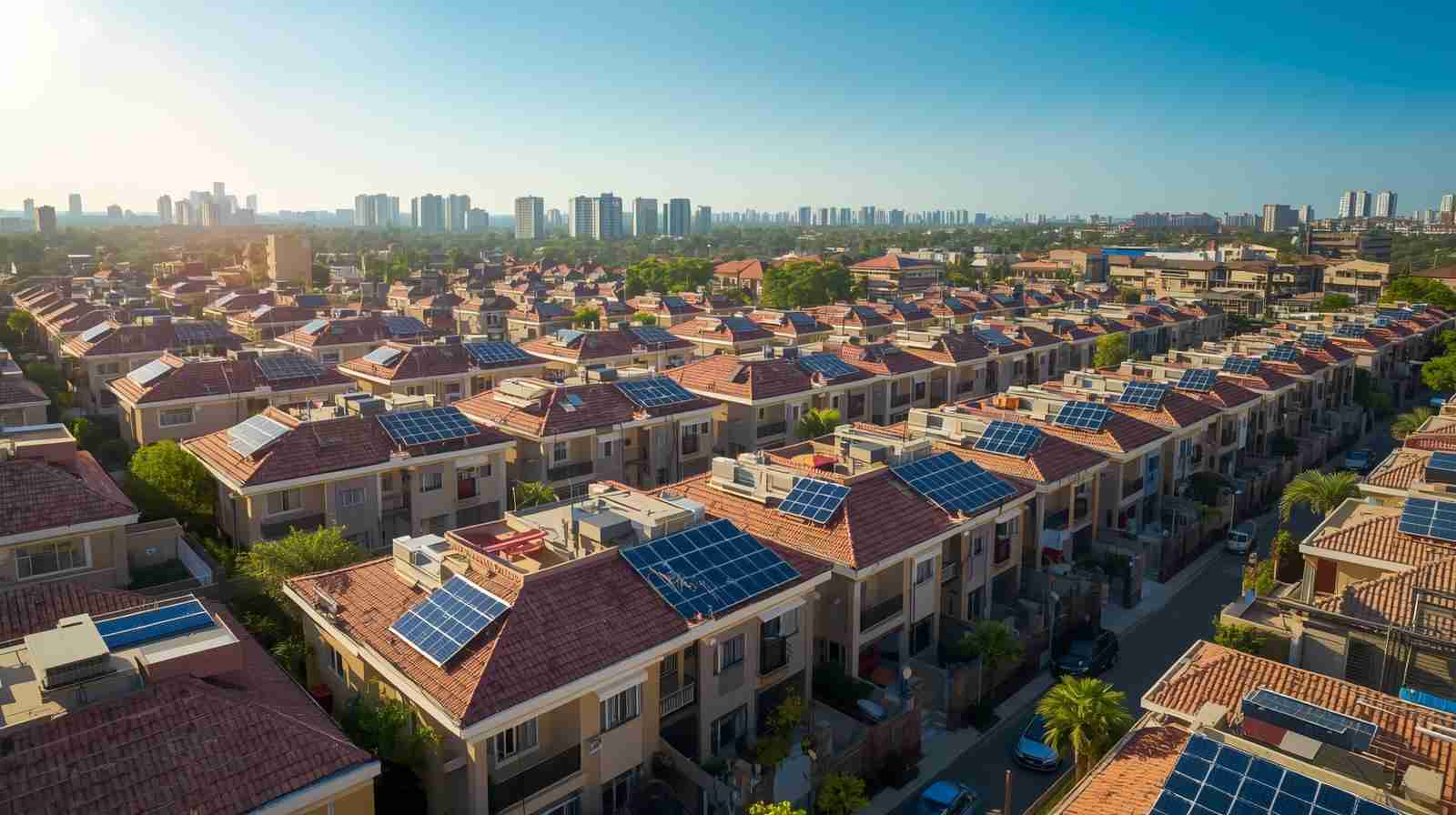
Rooftops across the country are experiencing a marked transformation. Homes, schools, offices, and businesses are all over India, in both large cities and in remote villages, changing their rooftops to use cleaner energy sources. India's commitment to energy independence and the future of green energy is greatly aided by rooftop solar, the renewables market with the fastest rate of growth in the world.
The future of rooftop solar in India appears to be brighter than ever thanks to rising electricity demand for all system stakeholders, environmental concerns, and encouraging policy signals. We must look back to see where we have been in order to look forward.
1. The Rise of Rooftop Solar in India
Well, the entire rooftop solar phenomenon happened in India due to the National Solar Mission initiated in 2010 - that’s when the race began. When we launched the program, everyone was enamored with the big solar parks that stretched literally a hundred kilometers. Then, solar panels started to get cheaper. Better tech rolled in. Suddenly, rooftop setups weren’t just for big companies or government buildings-shops, factories, even regular folks at home started jumping in. Basically, rooftop solar went from being an afterthought to the cool new trend in energy circles. Funny how fast things change when the price tag drops.
In 2015, rooftop solar was less than 10% of the entire solar capacity in India. By 2025, India's rooftop solar capacity exceeded 20 gigawatts (GW). However, there are differences in the growth rate of rooftop solar capacity across five states: Gujarat, Maharashtra, Rajasthan, Tamil Nadu, and Delhi.
Rooftop solar increased due to cheap solar models, increased efficiency, and public policy support. Rooftop solar became an economically viable mainstream activity from an expensive option.
2. Why Rooftop Solar Matters for India
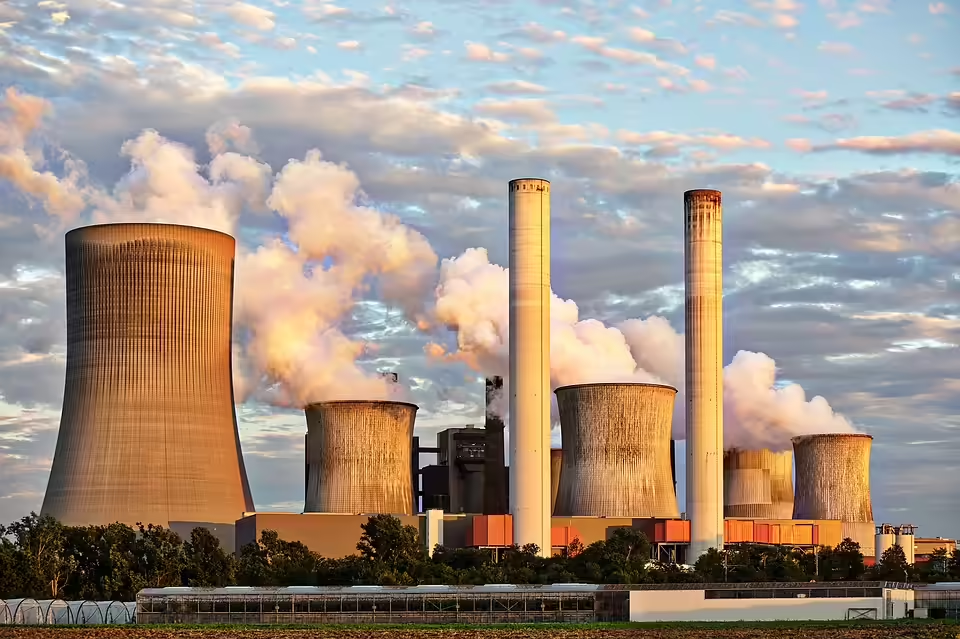
India's electricity consumption is set to increase twofold by 2030 as a result of rising population, industrialisation, and transport electrification. The power generation options currently employed, and heavily reliant on coal, are categorically untenable from an environmental and economic perspective.
Rooftop solar represents a compelling alternative:
- It reduces reliance on fossil fuels.
- It reduces transmission losses through the localised generation and consumption of the power.
- It allows people and local communities to become energy producers, as opposed to consumers.
- It lowers your electricity bill and creates long-run savings.
Rooftop solar enhances energy security for businesses and corporations that are connected to corporate sustainability scores, as these sustainability scores are becoming more and more linked to global ESG (environmental, social, governance) goals. For households, rooftop solar means energy independence and certainty in the face of continually rising utility prices.
3. Government Policies and Support
The government of India has identified rooftop solar as a vital part of its renewable mission, with initiatives to increase install base across all sectors:
Rooftop Solar Programme Phase II (Launched in 2019):
A prerequisite for the ambitious goal of attaining 40GW of rooftop solar capacity, the program provides up to a 40% subsidy for households with an onboard system of size up to 3KW, while a 20% subsidy is available for systems of between 3KW and 10KW capacity.
Net Metering Policies:
In a net metering policy, consumers are allowed to send the solar generated excess - that they generate from their rooftop solar modules - back to the grid and receive credits against their monthly utility bill.
PM-Surya Ghar Muft Bijli Yojana (2024):
This flagship program aims to put rooftop solar into one crore (10 million) families in India, where families would receive free rooftop solar energy up to 300 units a month.
Simple Online Portals:
The National Portal for Rooftop Solar (solarrooftop.gov.in) allows users an easy application and tracking process, as well as a seamless installation process for the consumer.
State governments have also been reporting additional subsidies and tax loopholes available to individuals as additional means to obtain loans (that are low or no interest) to provide further incentives to adopt the rooftop solar technology.
4. The Role of Technology and Innovation
Technological advancements and digital innovation will drive the future of rooftop solar installations in India. Trends related to these developments are as follows:
Smart Inverters and IoT Integration:
Smart inverters and IoT systems will provide real-time monitoring, enhancements to predictive maintenance, and optimization of performance via an app or mobile technology.
Solar + Battery Storage:
Hybrid rooftop systems will enable customers to have energy around-the-clock, even at night or during load-shedding situations, thanks to declining battery costs.
Building-Integrated photovoltaics (BIPV):
Solar panels could replace existing materials to build from roofing to glass in the near future. This would allow energy generation to be integrated and therefore not jeopardize aesthetics.
AI and Data Analytics:
Artificial Intelligence will help forecast energy production, manage load/generation of energy to the grid, and therefore improve efficiencies of operation.
These technologies will all help rooftop solar systems become more efficient, more manageable, and more scalable, leading to a larger and faster increase in adoption in the industry.
5. Economic & Environmental Benefits
Rooftop solar energy isn’t just clean - it’s smart economics. For households, the average payback period is between 4 to 6 years, at which point electricity is basically free for another 15–20 years. For businesses, it decreases operating expenses and increases overall brand value.
As a country, wide adoption of the solar rooftop could:
- Save billions of dollars in imported coal.
- Reduce carbon pollution by millions of tones annually.
- Create millions of green manufacturing, installation, and maintenance jobs.
The benefits of solar rooftop installations extends beyond personal and corporate savings to an overall environmental benefit by providing clean air, efficient water utilization, and sustainability development, creating more climate resilient municipalities.
6. Challenges on the Horizon
Rooftop solar has seen solid growth, however still has opportunity for improvement on a number of key areas: Awareness and education. There continues to be a general lack of knowledge regarding potential heating bill savings and government incentive programs.
Financing barriers. A greater up-front expense along with the lack of cost-effective financing may preclude a household or small business from purchasing solar rooftop systems.
Net metering. Varying policies state-to-state will continue to create confusion and lead to significant delays in the installations.
Quality and maintenance. At this time equipment, performance, and installer certifications lack standardization and can affect performance on flat roofs.
Grid stability. Achieving a balance between distributed electrical generation and electrical grid stability will be of ever growing importance as more residential and commercial rooftop solar is adopted.
Thus, improving each of these three key areas with better policy, financing models, and technical standards will be important for market growth.
Conclusion
India has a future with rooftop solar that is not just bright; it’s transformational. Rooftop solar means energy independence, responsible stewardship and economic empowerment. As rooftop solar panels become a regular sight across India, it is a very exciting time for India to step history toward a cleaner, greener, sustainable rational.
The sun is shining bright and abundant in India and is no longer only providing light; the sun is the power behind India's rise.