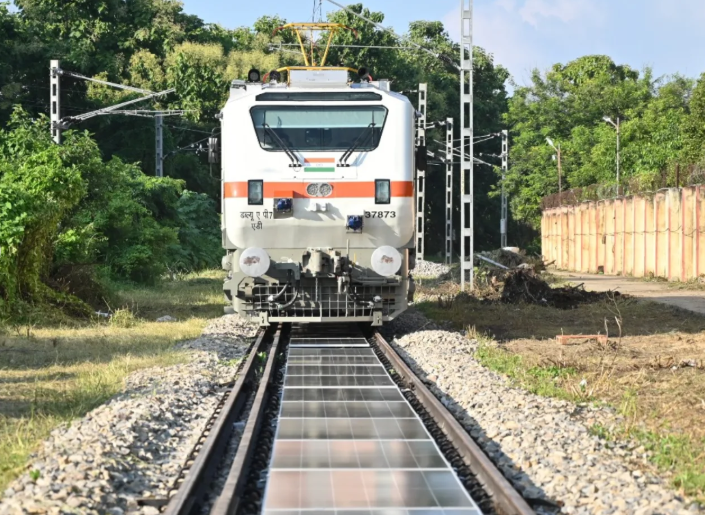
Indian Railways has launched the country’s first pilot project to generate solar energy by installing removable solar panels between active railway tracks. The initiative, commissioned at Banaras Locomotive Works (BLW), Varanasi, was inaugurated on Independence Day, August 15, 2025.
The pilot covers a 70-metre stretch on Line No. 19, where 28 solar panels with a total capacity of 15 kWp have been deployed. Officials said the design is unique as the panels can be easily removed for track maintenance, addressing a key operational concern.
Each solar module, measuring 2,278 × 1,133 × 30 mm and weighing 31.83 kg, is made using monocrystalline PERC bifacial cells with an efficiency of 21.31%. The panels are mounted to concrete sleepers with epoxy adhesive and rubber pads to prevent vibration shock through the panel structure from trains passing. Each panel is secured to the concrete slab using four stainless-steel Allen bolts that allow for fast removal of modules.
According to engineers, the pilot system has the potential to deliver an energy density of 880 units per kilometer per day, equivalent to 220 kWp per kilometer. At scale, if implemented across the 120,000 km Indian Railways network, the technology could generate nearly 321,000 units of electricity per kilometer annually without requiring additional land.
BLW General Manager Naresh Pal Singh termed the development as "a new dimension in the usage of solar energy." He cited the internal engineering personnel, especially Chief Electrical Service Engineer Bhardwaj Chaudhary, as part of the team that was instrumental in designing and executing the project.
This is in continuation with the wider green energy initiative of Indian Railways and identifies its larger goals of carbon-zero net emissions by the year 2030. The transporter had already rolled out rooftop solar plants at stations and offices and is investing in renewables on a larger scale as well.
Officials said that if the Varanasi pilot is successful, there will likely be a large rollout of the technology across the entire railway network.